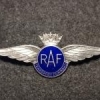
August 18, 20214 yr #1 Never did I think it would be possible for me to own an Irish World War II Sterling Army Air Corps pilot wing. There was one example known in the collecting community, a wing procured by a man I respect greatly for his diligence and thorough dedication not only to collecting insignia but entire uniforms and histories of the men who wore these badges and flew the most dangerous skies of world history, Tod Rathbone. While Ireland was neutral from a political standpoint, tens of thousands of Irish, North and South, served in the British army as well as providing some of the most talented pilots of the war who flew in the RAF, boasting 13 World War II Irish aces in the RAF alone! An Irish admiral was assassinated in Ireland by the IRA for helping people from the South sign up and enter the services of the British military. There were 163 incidents of belligerent aircraft either crashed landing or being pursued by the hawker hurricanes flown in the Irish Army Air corps and forced to land on Irish soil after penetrating Irish airspace. Some famous stories are told of the relationships built around those pilots both from the RAF and from the luftwaffe and their would-be pursuit pilots in the Irish Army Air Corps Hawker Hurricanes, as well as those who cared for them and their captivity. The Irish paid their share of blood as well under German bombs in the north and in the south Republic, including one of the most devastating of the war, the Belfast Blitz as it was called which cost 1,100 lives in Belfast and hit 50% the homes there leaving 100,000 temporarily homeless. The badge is different from what I thought it would be. I thought this badge was going to be very delicate and a mid-level skill set applied to the enameling and lettering framed by the enameling. I was wrong. The first thing I noticed when I unclipped it from the backboard the seller had attached it to, was the weight. This badge is a heavy little tank it makes me think of the Little World War I Renault tanks moving around the muddied battlefield and being hit by Small arms fire and grenades and taking all the punishment with a shrug. It is a die struck piece with a tiered construction. The actual Irish radiant sun which forms the bottom two tiers of the central Roundel is one die struck piece in which you have the sun's flames in a perfect circle at the base set on the obverse center of the wing foundation and then the radiant rays of sunlight are superior to the flames and in the form of triangles engraved with vertical lines emphasizing the radiance of the Sun. On the top obverse tier is set around Shield with a perfect pair of concentric circles which includes the inscription Óglaiġ na h-Éireann (Irish volunteers) in the outer circle. The Irish font stylized "FF" ie Fianna Fa'il, is in the inner circle; Fianna is the name of a third century version of a military force on the Irish Island and Fa'il is a term that means Destiny but you must look back to what Ireland was called over the years innishfa'il which means "island of destiny" and so it basically means Army of Ireland or Army of the Isle of destiny. The lettering is exquisite in the top central roundel as it is part of the die stamping of the top Shield, therefore it was actually hand-carved into the die by the die maker which took extreme skill in that micro engraving paradigm. The makers mark J.M.C⁰ is from Jewelry & Metal Manufacturing Company of Dublin which began business in the 1920s until 1970. The following assay marks are 1) The Hibernia mark indicative of Irish silver which is the lady sitting with the branch in her hand. 2) the crowned harp which is the city Mark of Dublin 3) the silver was stamped prior to being die-struck so the final letter, confirmed by the other known example and by the shape of the letter itself which remains in view, is the letter C which signifies 1944 when a wing of this design would have been made for the small Irish Defense Force Army Air Corps which was composed of pilot officers which were so few in number that by 1943 they instituted a flying Sergeant's program and in 43, 13 flying sergeants received their wings. By far the most common, although still extremely rare, Wing design for the Irish Army Air corps was a fabric design. I have seen four examples over the years of World War II Irish pilot wings in the fabric make. In the collecting community there is one Irish Sterling wing known to be in the museum of Tod Rathbone and the other badge is noted in this post. These fabric wings were identical in shape but of course were larger in their size, being created in sizes similar to the RAF fabric wings 4+ inches at times. These wings are 2 13/32 at my most precise reading, approx 2 3/8 in and built extremely heartily. The pin itself is very thick and has a strong tension holding it in place when set in the pin catch. As I noted above, when one picks up the wing, the first noticeable attribute is its weight because of the thickness of the silver content in the base wing structure and central escutcheon upon which the roundels are brazed in solid fixture.
August 18, 20214 yr #2 INCREDIBLE! I am in awe! I have known about the wing for years and have had several Irish friends attempt to locate an example for me. Obviously, none were successful. The detail work with the photos is top notch. I am appreciative of the time and effort that you went to in order to create this post. Thank you! Allan
August 18, 20214 yr Author #3 1 hour ago, Allan H. said: INCREDIBLE! I am in awe! I have known about the wing for years and have had several Irish friends attempt to locate an example for me. Obviously, none were successful. The detail work with the photos is top notch. I am appreciative of the time and effort that you went to in order to create this post. Thank you! Allan Alan, it seems you and I have a similar heart when it comes to collecting. This wing is by far one of the most treasured pieces I have been blessed with in my collection. The level of surprise when it arrived was far beyond what I can say with words and I still have it laid out where I can look at it every time I pass through the house because the awe just does not abate. I want to thank you for your encouragement and edification for finding this wing, it makes it all worthwhile when the experience is shared!


Create an account or sign in to comment